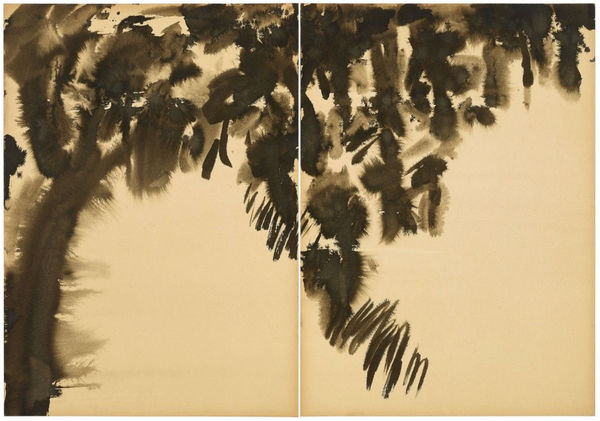
One of the great masters of ink of the second half of the 20th century, the work of T’ang Haywen reveals a profound universe, full of sensibility and of intensity. His artistic production focused essentially on landscapes and is marked by the use of ink. Following the Precepts of painting of Master Shitao, in which he finds at once a philosophical and aesthetic source, T’ang, an insatiable traveller, brought his brushes and his inks everywhere he went. Painting is, for him, a way of life.
The work of T’ang Haywen is never abstract as, in the fugitive, free brushstrokes he executes, in his instantaneous impressions, he always keeps the memory of landscapes, of water and hills, of grass bending in the wind. His landscaped are punctuated by simple signs, like a musical partition or a calligraphic scroll. Defining his position in regards to abstraction, T’ang writes: “I think complete abstraction is an impasse that can only justify itself through theory, can only express itself through the des-incarnated Verb…It is from a certain material figuration that painting can evolve, can renew itself without losing itself and can expand in the areas of emotion and spirituality.” The works of T’ang always convey an essentialized idea, but one nonetheless resulting from nature.
The interplay of positive and negative space remains an important part of T’ang’s works. A single trace is enough for T’ang in order to evoke nature, in an analogy that has been the mark of Taoist painting for centuries. The gesture of the artist responds to an interior need, as Shitao testified himself in his “Precepts on Painting”. T’ang utilizes the round brush, that transcribes all the movements of the hand, the paper preventing any retouch. This gesture becomes a bridge between the individual and the world, it is at once both subjective and universal. The luminous void of the white paper, traversed by serpentine strokes, is the best expression of life, where every spot of ink is a mark of vital energy.
It is this same philosophy of gesture that the great representatives of Lyrical Abstraction, like Soulages and Hartung, are searching for when they start to study Oriental philosophy. T’ang inscribes in his landscapes a characteristic fluidity, a vision of landscape painting that is founded not on the form, but on the spirit.