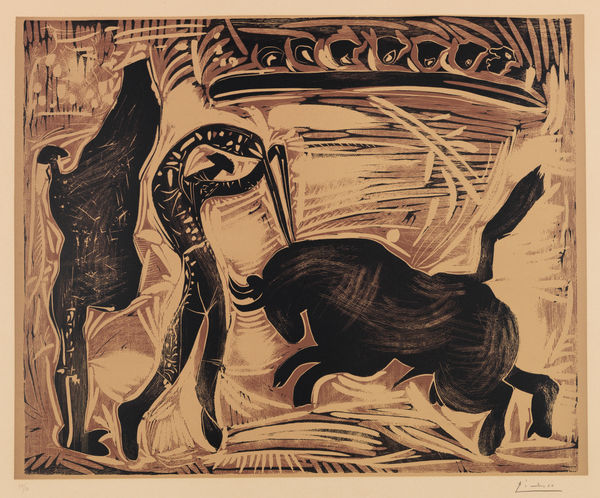
A true Spaniard by heart, the Corrida is one of Picasso's most emblematic subjects. Installed definitively in the South of France in 1947, Picasso returns to the subjects of his Mediterranean childhood - and also to bullfighting, spectating bullfights in Arles and Vallauris. Starting his collaboration with Suzanne Ramié of the Madoura ceramic workshop in Vallauris at the same time, the bullfight is one of his recurring themes in ceramic-making.
The bullfight fascinates Picasso ever since his childhood in Spain. A true Spaniard by heart, it is one of his most recurring themes in his significant oeuvre - be it in painting, drawing, engraving or ceramics. After the Second World War, Picasso comes to live in the South of France definitively. For him, it is the occasion to return to the Mediterranean myths and subjects of his childhood, as well as a certain joie de vivre and of creating.
This moment coincides perfectly with his meeting with Suzanne Ramié, owner of the Madoura ceramic workshop in Vallauris, with whom he starts a long and fertile artistic collaboration.Until the end of his life, he will work only with Madoura for the production of his ceramic editions. This is also the moment when he meets Hidalgo Arnéra in Vallauris, who teaches Picasso the technique of the linocut.
-
 Pablo PicassoLe Banderillero, 1959Linocut in colours62 × 75 cm
24 2/5 × 29 1/2 inEdition of 50Hand-signed by artist, Signed and numbered «40/50» -
Pablo PicassoPase de Muleta, 1959Round dish (terre de faïence/ earthenware, partially glazed with engobes and painted)42 cm diameter
16 1/2 in diameterEdition of 50, 35/50With the Empreinte Originale de Picasso and Madoura stamps. Numbered 35/50.