Max Ernst German, 1881-1976

A German painter and sculptor, he was a co-founder of both Dadaism (Cologne, 1919) and Surrealism. Traumatized by his service in the German artillery during World War I, he turned to art as a means to "rediscover the myths of his time." After settling in Paris in 1922 following his meeting with Paul Éluard, he broke with the Surrealist group in 1938 and subsequently fled war-torn Europe for the United States with the help of Peggy Guggenheim. A pioneer of semi-automatic techniques (such as *frottage*, *grattage*, and decalcomania), he developed a personal form of Surrealism—haunted by forests and German Romanticism—that gave shape to the traumatized inner world of 20th-century man. Honored with the Grand Prize at the Venice Biennale (1954) and the subject of numerous international retrospectives (at the Guggenheim, MoMA, Tate, and MNAM), he died in Paris in 1976.
-
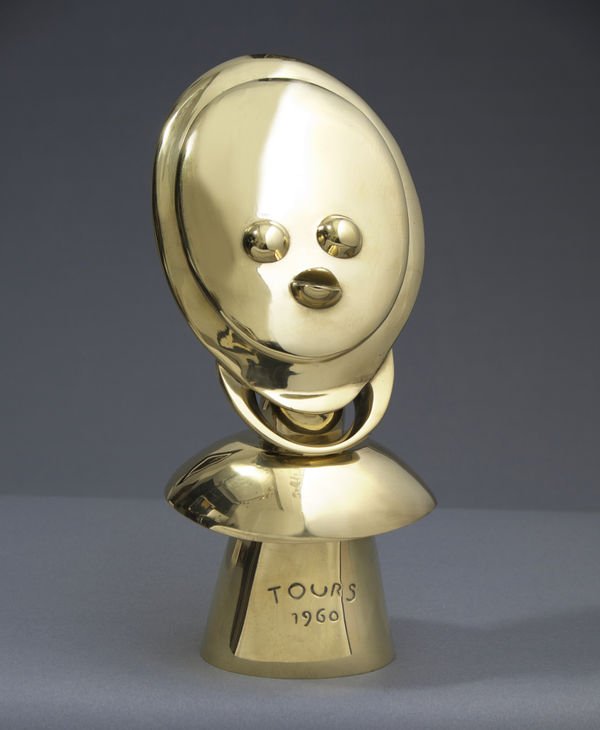
 Max ErnstLa Tourangelle, 1960Polished brass with golden patina27 cmI/III HCSigned, numbered and inscribed with the foundry mark 'Max Ernst I/III, Susse fondeur Paris'
-

BRAFA 2024
28 Jan - 4 Feb 2024Galerie Jean-François Cazeau, located in the Marais district of Paris since 2009, builds bridges between the Modern Masters and post-war art on both sides of...Read more -

PAD Paris 2023
29 Mar - 2 Apr 2023ARTISTES présentés : César Baldaccini (1921-1998), Olivier Debré (1920-1999), Max Ernst (1891-1976), Leonor Fini (1908-1996), T’ang Haywen (1927-1991), Auguste Herbin (1882-1960), Wifredo Lam (1902- 1982), Fernand Léger (1881-1955), Nicolas Lefeuvre (1975-), Sol LeWitt (1928-2007), André Lhote (1885- 1962), André Masson (1896-1987), Henri Matisse (1869-1954), Joan Miró (1893-1983), Pablo Picasso (1881-1973), Niki de Saint-Phalle (1930-2002), Tom Wesselmann (1931-2004)Read more
"Max Ernst died on August 1, 1914. He returned to life on November 11, 1918."
Max Ernst was born in 1891 in Brühl, near Cologne. As a child, he had a difficult relationship with his authoritarian father; he even ran away from home in 1896. During this flight, he was taken in by pilgrims who mistook him for the Christ child—a guise in which his father had previously depicted him in a painting. Thus, imagery and mysticism became part of his imaginative world from an early age. As he grew older, he pursued studies in philosophy and psychology; while these fields enriched his thinking on the unconscious and the creative process, they also served to deeply disappoint his demanding father.
World War I marked a true turning point in Max Ernst’s life and artistic output. Conscripted into the German infantry, he found the experience deeply traumatic. Later, in writings reflecting on this period, he famously stated: "Max Ernst died on August 1, 1914. He returned to life on November 11, 1918." By "being reborn" at the end of the war, Ernst was able to embark on his artistic career.
Indeed, in the wake of the war, Ernst became involved in the Dada movement, emerging as one of its leading figures. The movement took shape in Cologne in 1919, serving as a form of protest against the horrors and massacres of the era. His work from this period notably includes collages that express his anger at the rational logic and mechanization that had led to the catastrophe of the war.
It was not until 1922, following his meeting with Paul Éluard, that the artist moved to Paris. Influenced by the metaphysical works of Giorgio de Chirico, he gradually gravitated toward Surrealism, a movement then in its infancy. Ernst thus became a key figure in both Dadaism and Surrealism. However, he left the Surrealist movement in 1938 following André Breton’s mistreatment of Éluard.
In the 1940s, Ernst was arrested as a dissident in France. He managed to flee to Spain and then to the United States with the help of Peggy Guggenheim, who became his third wife. It was during this exile that he met his fourth wife, the painter Dorothea Tanning.
At the end of World War II, Ernst returned to France. This period marked a deepening of his Surrealist style, which had by then reached a level of maturity.
His work demonstrates an inventive artistic practice. Combining collage and painting, Ernst developed semi-automatic techniques that allowed forms to emerge beyond conscious control. These techniques included *frottage* (rubbing a pencil over various surfaces and reinterpreting the resulting patterns to create images), *grattage* (scraping), decalcomania, and drip painting. Some of these methods echo a reinterpretation of the "ready-made." It is also worth noting the prominence of forest scenes and nature in Ernst’s work; this clearly reflects the influence of German Romanticism on his imagination.
Ernst’s Surrealism differs from that of his peers: he sought neither to figuratively illustrate a "surreal" nature nor to produce purely automatic drawings that gave form to the subconscious. Instead, he created—in a semi-conscious manner—images that expressed the traumatized inner world of 20th-century humanity. Institutional recognition was cemented in the 1950s: in 1954, Ernst received the Grand Prize for painting at the Venice Biennale, followed the next year by a major retrospective at the Guggenheim Museum in New York. A series of retrospectives ensued: at the Musée National d'Art Moderne in Paris in 1959 (inaugurated by André Malraux), at the Tate Gallery in London, and at the Museum of Modern Art in New York.
Max Ernst died on April 1, 1976, in Paris.
-
BRAFA 2024
28 Jan - 4 Feb 2024Galerie Jean-François Cazeau, located in the Marais district of Paris since 2009, builds bridges between the Modern Masters and post-war art on both sides of...Read more -
PAD Paris 2023
29 Mar - 2 Apr 2023ARTISTES présentés : César Baldaccini (1921-1998), Olivier Debré (1920-1999), Max Ernst (1891-1976), Leonor Fini (1908-1996), T’ang Haywen (1927-1991), Auguste Herbin (1882-1960), Wifredo Lam (1902- 1982), Fernand Léger (1881-1955), Nicolas Lefeuvre (1975-), Sol LeWitt (1928-2007), André Lhote (1885- 1962), André Masson (1896-1987), Henri Matisse (1869-1954), Joan Miró (1893-1983), Pablo Picasso (1881-1973), Niki de Saint-Phalle (1930-2002), Tom Wesselmann (1931-2004)Read more