Gérard Schneider Swiss-French, 1896-1986
Gérard Schneider is one of the pioneers of lyrical abstraction, a gestural and personal form of abstraction that he developed alongside Hans Hartung and Pierre Soulages. Exhibiting at the Galerie Louis Carré in Paris from 1950 onwards, he conceived of painting as a gesture from which form emerges, without reference to external nature.
His work, by turns energetic and volcanic in the 1950s and later more luminous and balanced, can be seen as a musical composition, imbued with passion and romanticism. It is now held in major international institutions, from the Centre Pompidou to MoMA, including the Phillips Collection and the Gandur Foundation for Art.
-

ST-ART
LA FOIRE D’ART CONTEMPORAIN ET DE DESIGN DE STRASBOURG 26 - 28 Nov 2021We are participating in ST-ART, the contemporary art and design fair, which will celebrate its 25th anniversary from November 26 to 28, 2021, in Strasbourg....Read more -

Art Paris 2021
9 - 12 Sep 2021The First Modern and Contemporary Art Fair to Take Up Residence in the Grand Palais Éphémère on the Champ-de-Mars Art Paris will be the first...Read more
A major pioneer of Lyrical Abstraction, a gestural and personal form of abstraction, along with Hans Hartung and Pierre Soulages, Gérard Schneider was shown in Paris at the Galerie Louis Carré as early as 1950.
From 1955 to 1960, Schneider's work was exhibited at the Kootz Gallery in New York where an exclusivity contract connected the artist and the American dealer Samuel Kootz. From gesture, "the shape is born, whether lyrical or dramatic, with its colour and technical means, without any reference to external nature" according to Schneider. Eugène Ionesco spoke of "the original, eruptive, richness" of his work. From nervous gesture and volcanic composition, full of tension, of the 1950s followed "the light years" from Michel Ragon's expression, which were marked by the balance of forms reflecting each other and the explosion of colour. "Painting should be looked in the same way as music is listened to", as Schneider enjoyed saying. Musical, his work is to be understood like "an orchestra" which expresses "passion, fury, romanticism" according to Michel Ragon.
The works of Schneider are in museums including the Centre Pompidou in Paris, MoMa in New York, the Phillips Collection in Washington, the Museum of Fine Arts of Montréal and the Modern Art Museum of Rio de Janeiro, as well as private collections and foundations such as the Fondation Gandur pour l'Art in Geneva.
-
ST-ART
LA FOIRE D’ART CONTEMPORAIN ET DE DESIGN DE STRASBOURG 26 - 28 Nov 2021We are participating in ST-ART, the contemporary art and design fair, which will celebrate its 25th anniversary from November 26 to 28, 2021, in Strasbourg....Read more -
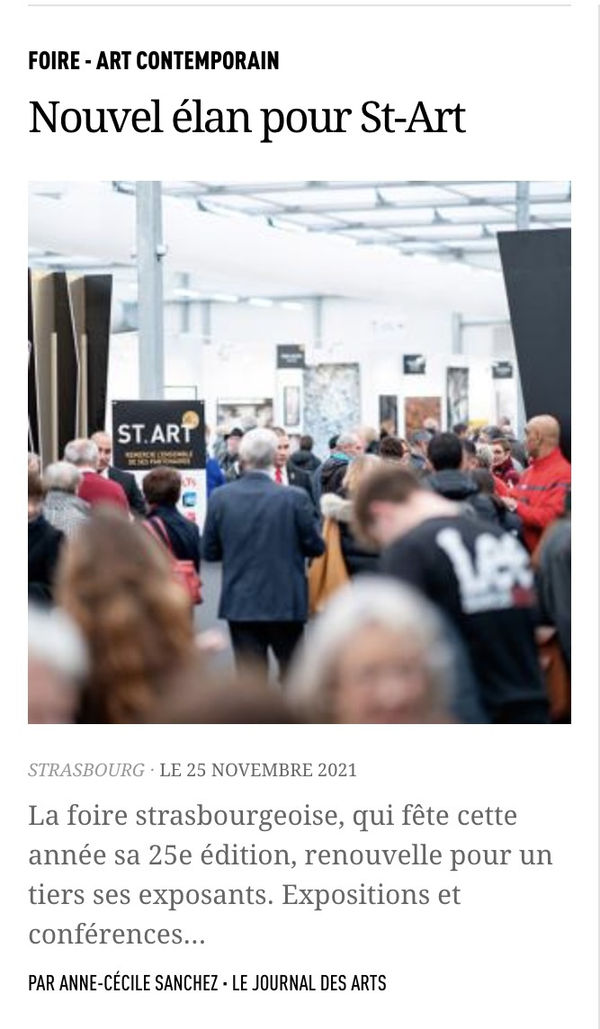
Nouvel élan pour St-Art
Le Journal des Arts Nov 25, 2021....This edition, which is intended to be European, will bring together 80 exhibitors, a quarter of which are foreign galleries and a third of which...Read more -
Art Paris 2021
9 - 12 Sep 2021The First Modern and Contemporary Art Fair to Take Up Residence in the Grand Palais Éphémère on the Champ-de-Mars Art Paris will be the first...Read more