Afro (Afro Basaldella) Italian, 1912-1976

An Italian painter born in Udine into a family of artists—his father and uncle were decorators, and his brothers Mirko and Dino were renowned sculptors—he began exhibiting in Milan in 1932 and started his career with decorative work in Italy. A stay in Paris with his brother Mirko, during which he discovered Cubism, had a lasting influence on his painting style. He settled in Rome in 1938 and was active in the Resistance in Venice during the war; in the post-war period, he kept his distance from overly politicized movements. His 1949 meeting with New York gallerist Catherine Viviano ushered in a pivotal American phase: he exhibited regularly in New York until 1968 and was influenced first by Gorky and later by the Action Painting of Kline and De Kooning. A member of the "Group of Eight" from 1952 onwards, and acclaimed at both the Venice Biennale (where he was awarded a solo exhibition and a prize in 1956) and MoMA (1955), he simultaneously pursued a career as a decorator and set designer (working on projects for UNESCO in Paris and opera houses in Munich, Cologne, and Palermo). A serious illness in 1971—occurring shortly after the death of his brother Mirko—led him to withdraw somewhat from the public eye, though he continued to work until his death in Zurich in 1976; his final years saw major retrospectives of his work, notably in Darmstadt in 1969.
-
 Afro (Afro Basaldella)Le Jardin de l'Espoir, 1958Mixed Media on paper mounted on canvas66 x 102 cm (26 x 40 1/4 in.)Signed and dated on the bottom right


Afro Basaldella was born in Udine on March 4, 1912.
His family had a strong interest in art: his father and uncle were respected decorators, and he began participating in their work while still a child. His brothers, Mirko and Dino, would go on to become famous sculptors.
After studying at art high schools in Florence and Venice, he launched his career as a painter at a young age, exhibiting his first canvases at the Galleria Il Milione in Milan in 1932.
In the following years, he created numerous decorative works, including the decoration of the O.B.N. college—now destroyed—and the Casa Cavazzini.
In 1936, he exhibited a series of portraits and still lifes at the Galleria della Cometa in Rome. The introductory text was written by Libero de Libero, who would later publish the first critical essay on Afro.
In 1937, in Rhodes, he decorated the Villa del Profeta and the Grand Hotel delle Rose.
He spent time in Paris with his brother Mirko, where he discovered Cubism—a revelation that proved fundamental to the evolution of his painting.
He settled in Rome in 1938, and an exhibition of his work was held there in 1942 at the Galleria di Roma.
After the war—having participated in the Resistance in Venice—Afro declined to join the *Fronte Nuovo delle Arti*, which he perhaps considered too politically engaged.
He exhibited in Rome between 1946 and 1948 at two galleries: the Galleria dello Zodiaco and the Galleria dell'Obelisco.
In 1949, he met Catherine Viviano, who was opening a gallery in New York with an exhibition featuring five Italian painters (including Afro). He exhibited at her gallery in 1950 and continued to do so regularly until 1968. During this period, he spent an extended time in the United States. He was influenced in particular by the painting of Gorky and, later, by the action painting of Kline and de Kooning.
In 1952, he joined the "Group of Eight," exhibiting with them at the Venice Biennale. In 1955, he participated in the exhibition *The New Decade*, organized by the Museum of Modern Art in New York, and was invited to serve on the jury for the Pittsburgh International.
In 1956, the Venice Biennale dedicated a room to his work, and he received the prize for best Italian painter.
From 1957 to 1958, he accepted a position as artist-in-residence at Mills College in Oakland, California; during this period, he created the large canvas *Le Jardin de l’Espoir* (The Garden of Hope) for the UNESCO building in Paris.
He also devoted himself to set design; in 1957, he created the sets and costumes for the ballet *Portrait de Don Quichotte* by Milloss and Petrassi, performed at the Rome Opera. Later, he would design sets for opera houses in Munich, Cologne, Palermo, and Ljubljana.
From 1958 onwards, he resided primarily in Italy, although he frequently traveled to the United States.
In 1969, a major retrospective exhibition featuring over two hundred of his works was held at the Kunsthalle in Darmstadt. This exhibition subsequently traveled to the National Gallery in Berlin and finally, in December of that same year, to the Palazzo dei Diamanti in Ferrara.
In 1971—shortly after the death of his brother Mirko—he was struck by a serious illness that profoundly altered his temperament. He became even more withdrawn and solitary, refusing to show his work to the public. After recovering, he resumed his work with renewed enthusiasm, exhibiting a significant body of work at the Editalia Gallery in Rome in 1973 and at the Il Milione Gallery in Milan in 1974. In 1970, he devoted himself to engraving and lithography for 2RC Editions.
He died in Zurich on July 24, 1976.
-
ARTE.IT
July 9, 2019 -
RIVIERAEVENTI.IT
June 29, 2019 -
IlNazionale
June 19, 2019 -
REDAZIONECORSARA
June 18, 2019 -
FIDEST
June 17, 2019 -
RIVIERA24.IT
June 17, 2019 -
ARTE.GO
June 16, 2019 -
LUSSOSTYLE.IT
June 14, 2019 -
CONNAISSANCE DES ARTS
July 26, 2013 -
CONNAISSANCE DES ARTS
July 18, 2013 -
GAZETTE DROUOT
July 5, 2013 -
GAZETTE DROUOT
July 5, 2013 -
BEAUX-ARTS MAGAZINE
July 3, 2013 -
TOUTELACULTURE.COM
May 10, 2013 -
9COLONNE
May 3, 2013 -
LeMonde.fr
April 20, 2013 -
QUOTIDIANOARTE
March 26, 2013
-

ARTE.IT
Jul 9, 2019Read more -
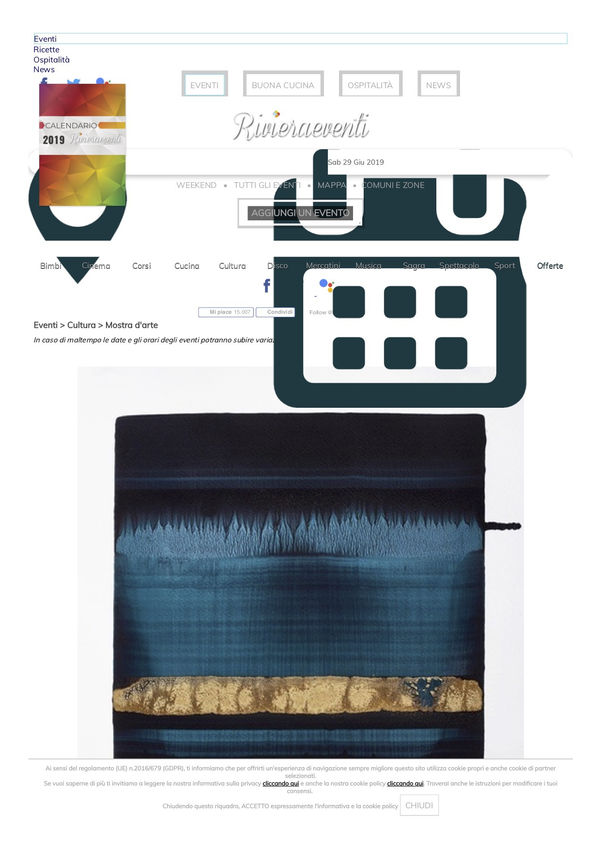
RIVIERAEVENTI.IT
Jun 29, 2019Read more -

IlNazionale
Jun 19, 2019Read more -

REDAZIONECORSARA
Jun 18, 2019Read more -

RIVIERA24.IT
Jun 17, 2019Read more -

FIDEST
Jun 17, 2019Read more -

ARTE.GO
Jun 16, 2019Read more -

LUSSOSTYLE.IT
Jun 14, 2019Read more -
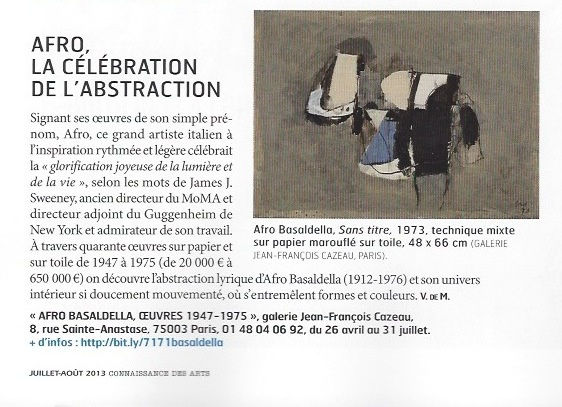
CONNAISSANCE DES ARTS
Jul 26, 2013Read more -

CONNAISSANCE DES ARTS
Jul 18, 2013Read more -

GAZETTE DROUOT
Jul 5, 2013Read more -

GAZETTE DROUOT
Jul 5, 2013Read more -
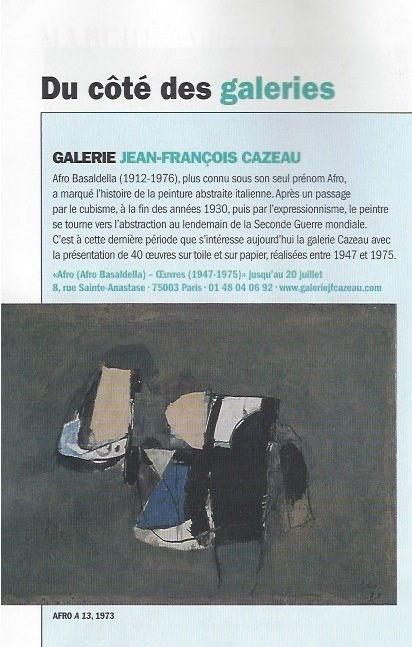
BEAUX-ARTS MAGAZINE
Jul 3, 2013Read more -
TOUTELACULTURE.COM
May 10, 2013Read more -

9COLONNE
May 3, 2013Read more -

AFRO
Afro Basaldella, Works from 1947-1975 26 Apr - 20 Jul 2013Read more -
LeMonde.fr
Apr 20, 2013Read more -
QUOTIDIANOARTE
Mar 26, 2013Read more