Serge Charchoune Russian, 1888-1975
Overview

Serge Charchoune
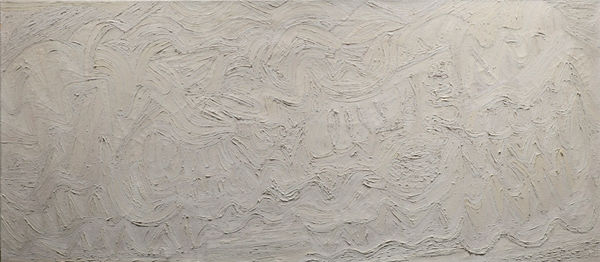
Inspiré par les Sylphides de Chopin Var. II, 1962
Oil on canvas
80 x 180 cm
Signed and dated on the lower right corner.
Titled and localized on the back.
Titled and localized on the back.
A singular figure of the 20th-century avant-garde, Serge Charchoune developed an oeuvre that eludes established categories and artistic movements. From his early Cubist and Dada experiments to a more ornamental and symbolic form of painting, he explored the simplification of form, colour and rhythm. Informed by Russian and Spanish folk traditions, his work thus evolved through a constant dialogue between abstraction, figuration and ornament.
Works
-
 Serge CharchouneInspiré par les Sylphides de Chopin Var. II, 1962Oil on canvas80 x 180 cmSigned and dated on the lower right corner.
Titled and localized on the back.
Video

Events

Biography
Serge Charchoune
Inspiré par les Sylphides de Chopin Var. II, 1962
Oil on canvas
80 x 180 cm
Signed and dated on the lower right corner.
Titled and localized on the back.
Titled and localized on the back.
Like the title of his magazine "Transbordeur", which he founded in 1921, Serge Charchoune eludes the boundaries and linear narrative of twentieth-century modernism. Arriving in Paris in 1912, Charchoune joined Henri Le Fauconnier's studio, shortly after the Cubist scandal of 1911. During the war, he crossed the Spanish border, as did Sonia Delaunay, Marie Laurencin and Albert Gleizes. It was in Spain that he made his first contacts with the Dada group, notably Francis Picabia and the poet-boxer Arthur Cravan. It was in this way that Charcoune managed to "bury cubism" in 1920 in the pages of Dada publications, a powerful symbolic act. In 1921, he was one of the artists and writers who signed Picabia's Oeil cacodylate.
Nonetheless, Charchoune carried with him the vast ornamental and folk tradition of his native Russia, as well as the Spanish folk art he discovered on his travels. With the essoufflement of Dada, Charchoune returned to the sources of his art, while reinterpreting them. He passed the purism of Ozenfant and Le Corbusier, pushing simplification and stripping down to their goal. From the 1940s onwards, he created a more ornamental, highly symbolic form of Cubism. His works became increasingly colourful, in a search for formal and chromatic rhythm.
Related content

