Gaston Chaissac French, 1910-1964

Framed: 53 x 48 cm (21 x 19 in.)
A self-taught painter born in Avallon, he was introduced to painting relatively late in life—in 1937—by Otto Freundlich and Jeanne Kosnick-Kloss. Settling in the Vendée region in 1943, he produced a body of work long considered marginal—described as "genius tinkering"—yet championed as early as the 1940s by Dubuffet, Paulhan, and Queneau, who had noticed him at the Salon des Indépendants and maintained an extensive correspondence with him. Although briefly associated with the Art Brut movement defined by Dubuffet, he was ultimately excluded from it; this did not, however, hinder the gradual recognition of his work—spanning both painting and literature (poems, letters)—which he himself termed "modern rustic painting." Despite remaining isolated in the provinces and kept at a distance by those around him, he enjoyed a notable exhibition in Paris in 1961, three years before dying in destitution in La Roche-sur-Yon. Posthumous recognition—cemented by a retrospective at the Musée National d'Art Moderne in 1973, followed by others in Nantes (1998) and at the Jeu de Paume (2000)—has established him today as a major figure in French art of the 1950s.
-
 Gaston ChaissacSelf Portrait, 1938Oil on board27 x 21 cm (10 5/8 x 8 1/4 in.)
Framed: 53 x 48 cm (21 x 19 in.)Signed chaissac on lower left


-

PAD 2022
Design + Art 5 - 10 Apr 2022Read more -

Art Paris 2021
9 - 12 Sep 2021The First Modern and Contemporary Art Fair to Take Up Residence in the Grand Palais Éphémère on the Champ-de-Mars Art Paris will be the first...Read more -

ART PARIS 2020
10 - 13 Sep 2020Art Paris 2020, the modern and contemporary art fair, is reborn at the Grand Palais from September 10 to 13. It will be the first...Read more -

BRAFA 2020
26 Jan - 2 Feb 2020La Brafa est réputée pour la qualité haut de gamme des œuvres exposées, des antiquités à l’art moderne et contemporain en passant par les beaux-arts...Read more
Framed: 53 x 48 cm (21 x 19 in.)
Long considered marginal, the work of Gaston Chaissac—described as a "genius tinkerer"—is increasingly recognized for its originality and scope. Acclaimed in his time by Jean Dubuffet, Jean Paulhan, Raymond Queneau, and many others, his work was, around 1946, associated with what Dubuffet defined as *Art Brut*. Although Dubuffet ultimately excluded him from that famous collection, a retrospective view of Chaissac’s work—rich in variety and supported by an abundant literary output of poems and letters—has since revealed its true importance and complexity. Within the context of 1950s art, Chaissac demonstrates how that era, following the triumph of abstract art, sought free and spontaneous expression. Eclectic, inventive, and intuitive, Chaissac’s work is best defined—in his own words—as "modern rustic" painting.
Born in Avallon in 1910, Gaston Chaissac tried his hand at various trades early on before meeting Otto Freundlich and Jeanne Kosnick-Kloss in Paris in 1937; they introduced him to painting. He held his first exhibition in Paris in 1939. In 1942, while working in a harness-making workshop in Saint-Rémy-de-Provence, he met several artists who encouraged his work, including Albert Gleizes, André Lhote, and Charles Mauron. In 1943, he settled with his family in Boulogne, in the Vendée region. Between 1943 and 1945, he exhibited at the Salon des Indépendants, where he caught the attention of Raymond Queneau, Jean Paulhan, and Jean Dubuffet—marking the beginning of an extensive correspondence with them. In fact, Dubuffet wrote the preface for his 1947 exhibition at the L'Arc-en-Ciel gallery in Paris. In 1948, he settled in Sainte-Florence-de-l'Oie (Vendée) after his wife was appointed as a schoolteacher there. In 1951, Gallimard published Hippobosque au bocage, a collection of letters and poems compiled by Jean Dubuffet. From 1958 to 1960, he was a regular contributor to the Nouvelle NRF. However, he lived an increasingly isolated life in a region that met him with little more than sarcasm. Yet, 1961—the year his family moved to Vix—also marked his breakthrough in Paris with an exhibition at the Iris Clert gallery. He died three years later, in 1964, at the hospital in La Roche-sur-Yon, living in the same state of destitution he had known all his life.
In 1973, the Musée National d'Art Moderne held a retrospective of his work; a decade after his death, this exhibition firmly established his reputation as one of the finest creative artists of his era. He was also the subject of two major retrospectives: one in 1998 at the Musée des Beaux-Arts in Nantes, and another in 2000 at the Galerie Nationale du Jeu de Paume in Paris.
-

La Figuration dans tous ses états : la figuration moderne au XXe siècle
11 Apr - 2 Jun 2025While abstraction represents the great paradigm shift of the 20th century, other artists rejected the academic and bourgeois tradition through figuration. While Cubism is considered...Read more -
PAD 2022
Design + Art 5 - 10 Apr 2022Read more -
Art Paris 2021
9 - 12 Sep 2021The First Modern and Contemporary Art Fair to Take Up Residence in the Grand Palais Éphémère on the Champ-de-Mars Art Paris will be the first...Read more -
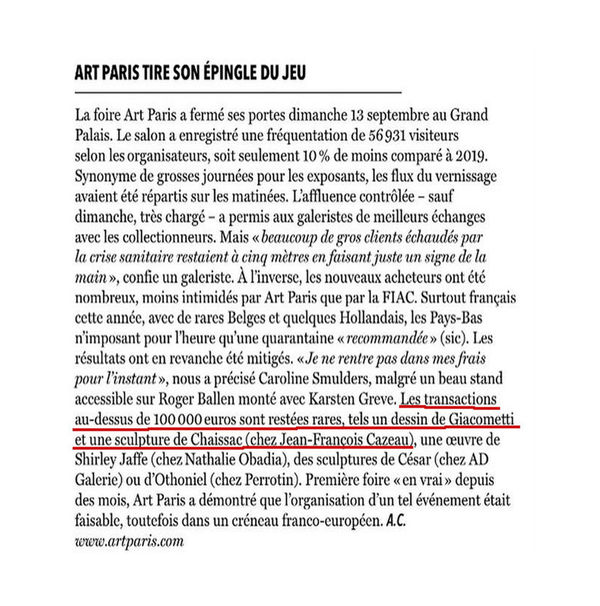
Art Paris tire son épingle du jeu
The Art Newspaper Sep 15, 2020Read more -
ART PARIS 2020
10 - 13 Sep 2020Art Paris 2020, the modern and contemporary art fair, is reborn at the Grand Palais from September 10 to 13. It will be the first...Read more -

BRAFA Art Fair 2020
Jan 31, 2020Read more -
BRAFA 2020
26 Jan - 2 Feb 2020La Brafa est réputée pour la qualité haut de gamme des œuvres exposées, des antiquités à l’art moderne et contemporain en passant par les beaux-arts...Read more