André Masson French, 1896-1987
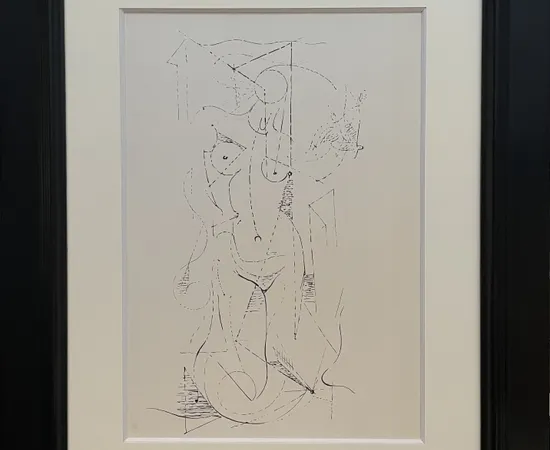


16 1/10 × 9 2/5 in
André Masson was a French painter born in 1896 in Balagny-sur-Thérain and died in 1987 in Paris. Trained in Brussels and then Paris, he practiced a personal form of Cubism after the First World War, before his studio on Rue Blomet, through his contact with Georges Bataille, André Breton, and Louis Aragon, became one of the centers of Surrealism, a movement he joined in 1923. A pioneer of pictorial automatism from 1927 onward, he developed a body of work marked by his time in Spain and then by his exile in the United States during the Second World War, where his painting notably influenced young American abstract expressionists, including Jackson Pollock. Returning to Provence in 1947, he entered a more serene period, nourished by his admiration for Renoir and Chinese painting.
-
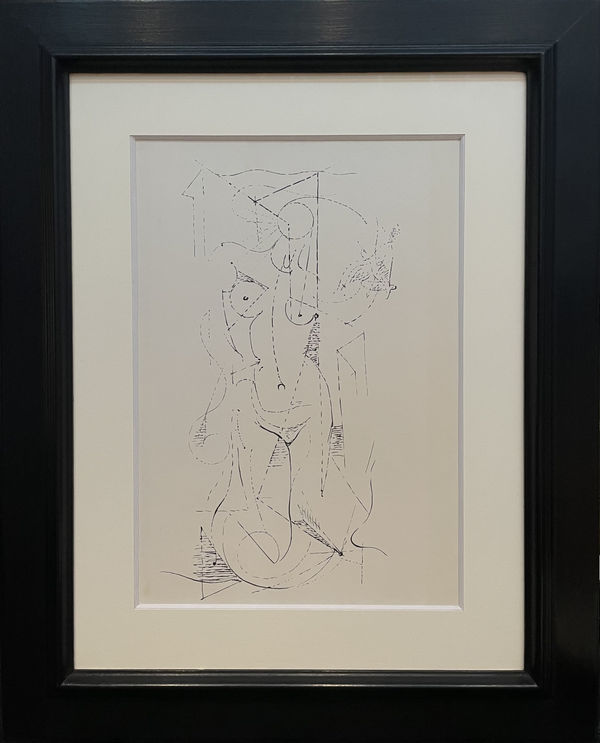
 André MassonStudy for Femme tenant un oiseau, 1924Ink on paper
41 × 24 cm
16 1/10 × 9 2/5 in -
André MassonL'entrée du taureau, 1937Oil on canvas26 x 67 cmSigned on the upper left corner
-
André MassonDans le pur néant. À la cîme de l'Être, 1939India ink on paper63 × 48 cmSigned on the lower right and titled on the reverse
-
André MassonLa Légende de Thésée, 1939Oil on canvas61 x 50 cm
24 × 19 7/10 inHand-signed by artist, Signed on the lower left -
André MassonLa Ville crânienne, 1940Ink and watercolour on paper.18 9/10 × 24 2/5 in / 48 × 62 cmHand-signed by artist
Signed by the artist on the lower-left corner. -
André MassonForêt: Martinique, 1941India ink on paper63 × 48 cmSigned, titled and dated by the artist on the lower right corner.
-
André MassonL'Enfantement, 1947Gouache and charcoal on paper
33 × 24.5 cm
13 × 9 3/5 inTitled, dated and inscribed by the artist on the upper left -
André MassonEnfantement, 1955Gouache, ink and pastel on paper25 3/5 × 21 7/10 in | 65 × 55 cm with frame includedHand-signed by artist, Signed on the lower right corner
-
André MassonFête , 1956Oil on Canvas90 x 81 cmSigned on the lower left side "André Masson"
-
André MassonFête, 1956Oil on canvas35 2/5 × 31 9/10 in / 90 × 81 cmHand-signed by artist
Signed on the lower-left corner "André Masson" -
André MassonPoursuite, 1933Oil on canvas81 x 116 cm (32 x 45 ¾ in.)Signed, lower left
-
André MassonAmoroso, 1939Bronze
Cast in 1986-8743.5 x 63.3 x 31.8 cm (17 1/8 x 25 x 12 ½ in.)Edition of 8, 0/8Signed with initials « A M » on the right, with foundry mark "E.Brustolin, Verona” -
André MassonPortrait de Peter Matisse, 1943Pastel on paper49 x 39 cm (9 3/8 x 15 3/8 in.)
Framed: 65 x 55 cmSigned on the lower left -
André MassonJeux d'oiseaux, c. 1965Felt pen on tracing paper35 x 35.5 cm (13 ¾ x 14 in.)Signed on the lower left, "André Masson"


-

Fine Arts Paris 2026
Stand C23 - Grand Palais September 21, 2026Read more -

Salon du Dessin Preview 2026
A Preview of our selection for the upcoming Salon du Dessin 2026 at the Palais Brongniart where the gallery will participate for the first time. February 21, 2026Opened in 2009 next to the Picasso Museum in Paris, in the heart of the Marais district, the Galerie Jean-François Cazeau is both the heir...Read more -

BRAFA 2026 PREVIEW
January 9, 2026Discover our highlights for the BRAFA 2026, in Brussels, from January 25th to the 1st of February.Read more -

BRAFA Art Fair 2024
January 24, 2024Read more -

BRAFA Art Fair 2020
January 31, 2020Read more
-
La Figuration dans tous ses états : la figuration moderne au XXe siècle
11 Apr - 2 Jun 2025While abstraction represents the great paradigm shift of the 20th century, other artists rejected the academic and bourgeois tradition through figuration. While Cubism is considered one of the foundations of...Read more -
CSEDT: La Semaine de Galeries Parisiennes
Parcours de la Chambre Syndicale de l'Estampe, du Dessin et du Tableau 28 Nov - 8 Dec 2024Read more -
André MASSON: Le Surréalisme révolutionnaire
Parcours Paris Surréaliste 27 Sep - 21 Dec 2024 ParisCommitted and sensitive to the spirit of his time, the artist maintained fruitful artistic collaborations, notably with Georges Bataille. Masson's art is in continuous renewal. Claiming a “native disposition for...Read more


-

Salon du Dessin 2026
Palais Brogniart (Place de la Bourse 75002 Paris) 25 - 30 Mar 2026For its first-ever participation in the Salon du Dessin, the gallery is presenting an exhibition that highlights the variations in 20th-century work on paper. Works...Read more -

FAB 2025 : Fine Arts La Biennale
20 - 24 Sep 2025This year, for its second participation in FAB Paris, which will be held at the Grand Palais from 20 to 24 September 2025, the Galerie...Read more -

BRAFA Art Fair 2025
26 Jan - 2 Feb 2025As every year, the gallery is delighted to showcase its selection of Impressionnist and Modern works at the BRAFA Art Fair in Brussels, in an eclectic booth.Read more -

BRAFA 2024
28 Jan - 4 Feb 2024Galerie Jean-François Cazeau, located in the Marais district of Paris since 2009, builds bridges between the Modern Masters and post-war art on both sides of...Read more -

PAD Paris 2023
29 Mar - 2 Apr 2023ARTISTES présentés : César Baldaccini (1921-1998), Olivier Debré (1920-1999), Max Ernst (1891-1976), Leonor Fini (1908-1996), T’ang Haywen (1927-1991), Auguste Herbin (1882-1960), Wifredo Lam (1902- 1982), Fernand Léger (1881-1955), Nicolas Lefeuvre (1975-), Sol LeWitt (1928-2007), André Lhote (1885- 1962), André Masson (1896-1987), Henri Matisse (1869-1954), Joan Miró (1893-1983), Pablo Picasso (1881-1973), Niki de Saint-Phalle (1930-2002), Tom Wesselmann (1931-2004)Read more -

PAD 2022
Design + Art 5 - 10 Apr 2022Read more -

Art Paris 2021
9 - 12 Sep 2021The First Modern and Contemporary Art Fair to Take Up Residence in the Grand Palais Éphémère on the Champ-de-Mars Art Paris will be the first...Read more -

WOP Art
Work on Paper Fair, 5th Edition 26 Nov - 27 Dec 2020Galerie Jean François Cazeau is pleased to announce its participation in the fifth edition of WOPart, one of the most important fairs specialized in Modern...Read more -

Galeristes
Le Pari(s) : Semaine de l'Art 23 - 25 Oct 2020Read more -

ART PARIS 2020
10 - 13 Sep 2020Art Paris 2020, the modern and contemporary art fair, is reborn at the Grand Palais from September 10 to 13. It will be the first...Read more -

BRAFA 2020
26 Jan - 2 Feb 2020La Brafa est réputée pour la qualité haut de gamme des œuvres exposées, des antiquités à l’art moderne et contemporain en passant par les beaux-arts...Read more
16 1/10 × 9 2/5 in
André Masson, born on January 4th, 1896, is a major figure of the surrealist movement and considered one of the fathers of automatism, as well as a strong influencer on the abstract expressionist movement which was born in New York during the 1940's.
Masson's career as a surrealist truly took shape in 1922, after he moved to the Atelier Blomet in Paris which became to the surrealists what the Bateau Lavoir was to the cubists. His close contact to Joan Miro took Masson's artistic production to an irrationallevel, one that he had not reached before. A couple years later, Masson became one of the most important artists to sign with Galerie Simon, the gallery of the famous dealer, Henri Kanhweiler. Masson's involvement with Kanhweiler and other artists of the gallery, notably Juan Gris, kept cubism essential to Masson's early surrealist works. With the likes of Joan Miro and Max Ernst, Masson always pushed the boundaries of experimentation by integrating various techniques, material and support into his production. In 1927, Masson he began experimenting with sculpture, using terracotta, clay and plaster.
Famous for his "automatic drawings" and his "sand paintings", he is marked - on an aesthetic level - by "the spirit of metamorphosis" and "the mythical invention" and - on an ethical level - by a visceral anti-conformism, including within the surrealist group from which he eventually moved away from.However, Masson remained a true surrealist: never throughout his artistic production did he abandon the surrealist aesthetics.
Having narrowly escaped death during the First World War, and being sensitive to the writings of Sade and his friend Georges Bataille, his work can be interpreted as an uncompromising questioning of human barbarity and perverse behavior. This preoccupation with all aesthetic considerations taking a primary role in his artistic language explains the role he plays in modern art by the fact that "he never cared to please."
His influence is mainly notable in New York during the Second World War, where he stayed after fleeing Nazi Germany. His paintings break with the classic pattern of figures standing out against a background in order to best symbolize the state of mental confusion that - according to him - governed his century. And his work served as a reference to founders of abstract expressionism, primarily with the painters Jackson Pollock and Arshile Gorky.
-
7 folles expos gratuites pour fêter les 100 ans du surréalisme en 2024
Beaux-Arts Magazine, September 17, 2024 -
ARTE.IT
July 9, 2019 -
RIVIERAEVENTI.IT
June 29, 2019 -
IlNazionale
June 19, 2019 -
REDAZIONECORSARA
June 18, 2019 -
Instantart
June 17, 2019 -
FIDEST
June 17, 2019 -
RIVIERA24.IT
June 17, 2019 -
ARTE.GO
June 16, 2019 -
LUSSOSTYLE.IT
June 14, 2019 -
MONACO MADAME
April 27, 2018 -
L'OBJET D'ART
January 15, 2010
-
Fine Arts Paris 2026
Stand C23 - Grand Palais Sep 21, 2026Read more -

Salon du Dessin 2026
Palais Brogniart (Place de la Bourse 75002 Paris) 25 - 30 Mar 2026For its first-ever participation in the Salon du Dessin, the gallery is presenting an exhibition that highlights the variations in 20th-century work on paper. Works...Read more -
Salon du Dessin Preview 2026
A Preview of our selection for the upcoming Salon du Dessin 2026 at the Palais Brongniart where the gallery will participate for the first time. Feb 21, 2026Opened in 2009 next to the Picasso Museum in Paris, in the heart of the Marais district, the Galerie Jean-François Cazeau is both the heir...Read more -
BRAFA 2026 PREVIEW
Jan 9, 2026Discover our highlights for the BRAFA 2026, in Brussels, from January 25th to the 1st of February.Read more -
FAB 2025 : Fine Arts La Biennale
20 - 24 Sep 2025This year, for its second participation in FAB Paris, which will be held at the Grand Palais from 20 to 24 September 2025, the Galerie...Read more -

La Figuration dans tous ses états : la figuration moderne au XXe siècle
11 Apr - 2 Jun 2025While abstraction represents the great paradigm shift of the 20th century, other artists rejected the academic and bourgeois tradition through figuration. While Cubism is considered...Read more -
BRAFA Art Fair 2025
26 Jan - 2 Feb 2025As every year, the gallery is delighted to showcase its selection of Impressionnist and Modern works at the BRAFA Art Fair in Brussels, in an eclectic booth.Read more -

André MASSON: Le Surréalisme révolutionnaire
Parcours Paris Surréaliste 27 Sep - 21 Dec 2024Committed and sensitive to the spirit of his time, the artist maintained fruitful artistic collaborations, notably with Georges Bataille. Masson's art is in continuous renewal....Read more -

7 folles expos gratuites pour fêter les 100 ans du surréalisme en 2024
Beaux-Arts Magazine Sep 17, 2024En parallèle de la grande expo du Centre Pompidou, de nombreuses galeries parisiennes proposent une programmation spéciale pour fêter les 100 ans du… On le...Read more -
BRAFA 2024
28 Jan - 4 Feb 2024Galerie Jean-François Cazeau, located in the Marais district of Paris since 2009, builds bridges between the Modern Masters and post-war art on both sides of...Read more -
BRAFA Art Fair 2024
Jan 24, 2024Read more -
PAD Paris 2023
29 Mar - 2 Apr 2023ARTISTES présentés : César Baldaccini (1921-1998), Olivier Debré (1920-1999), Max Ernst (1891-1976), Leonor Fini (1908-1996), T’ang Haywen (1927-1991), Auguste Herbin (1882-1960), Wifredo Lam (1902- 1982), Fernand Léger (1881-1955), Nicolas Lefeuvre (1975-), Sol LeWitt (1928-2007), André Lhote (1885- 1962), André Masson (1896-1987), Henri Matisse (1869-1954), Joan Miró (1893-1983), Pablo Picasso (1881-1973), Niki de Saint-Phalle (1930-2002), Tom Wesselmann (1931-2004)Read more -
PAD 2022
Design + Art 5 - 10 Apr 2022Read more -
Art Paris 2021
9 - 12 Sep 2021The First Modern and Contemporary Art Fair to Take Up Residence in the Grand Palais Éphémère on the Champ-de-Mars Art Paris will be the first...Read more -
WOP Art
Work on Paper Fair, 5th Edition 26 Nov - 27 Dec 2020Galerie Jean François Cazeau is pleased to announce its participation in the fifth edition of WOPart, one of the most important fairs specialized in Modern...Read more -
Galeristes
Le Pari(s) : Semaine de l'Art 23 - 25 Oct 2020Read more -
ART PARIS 2020
10 - 13 Sep 2020Art Paris 2020, the modern and contemporary art fair, is reborn at the Grand Palais from September 10 to 13. It will be the first...Read more -
BRAFA Art Fair 2020
Jan 31, 2020Read more -
BRAFA 2020
26 Jan - 2 Feb 2020La Brafa est réputée pour la qualité haut de gamme des œuvres exposées, des antiquités à l’art moderne et contemporain en passant par les beaux-arts...Read more -

ARTE.IT
Jul 9, 2019Read more -
RIVIERAEVENTI.IT
Jun 29, 2019Read more -

IlNazionale
Jun 19, 2019Read more -

REDAZIONECORSARA
Jun 18, 2019Read more -

RIVIERA24.IT
Jun 17, 2019Read more -

FIDEST
Jun 17, 2019Read more -

Instantart
Jun 17, 2019Read more -

ARTE.GO
Jun 16, 2019Read more -

LUSSOSTYLE.IT
Jun 14, 2019Read more -

MONACO MADAME
Apr 27, 2018Read more -
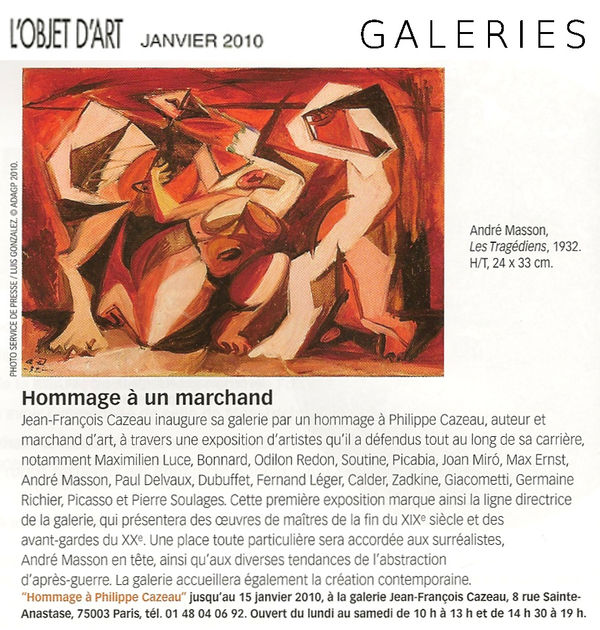
L'OBJET D'ART
Jan 15, 2010Read more