Yves Klein French, 1928-1962
-
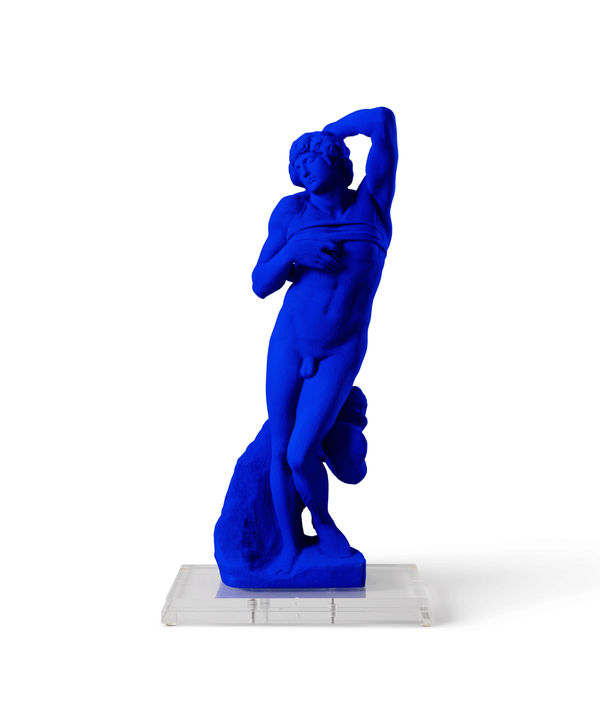
 Yves KleinL'Esclave mourant d'après Michel-Ange, 1962IKB Pigment and synthetic resin on plaster59 × 18 × 13 cmEdition of 300, Numbered 127/300Numbered 127/300 on the label posed on the underside, and signed R. Klein-Moquay
 -
Yves KleinTable IKB® , 1961Glass, plexiglass, chrome base and IKB blue pigments.37 x 100 x 125 cmEdition de la Fondation Yves KleinSignée par Rotraut Klein-Moquay et référencée sur son cartel d'identification sous le plateau
-
Yves KleinTable Monogold ™, Créée en 19613000 feuilles d’or, plexiglas, verre et pieds en acier chromé37 x 100 x 125 cm
Cette pièce fait partie d’une édition commencée en 1963, sous la supervision de Rotraut Klein-Moquay et basée sur un modèle de Yves Klein.Signée par Rotraut Klein-Moquay et référencée sur son cartel d'identification sous le plateau -
Yves KleinTable Monopink™ , Créée en 1961Pigment rose, Plexiglas, verre et pieds en acier chromé
37 x 100 x 125 cm (49 5/8 x 15 3/8 x 39 3/8 in.)
Cette pièce fait partie d’une édition commencée en 1963, sous la supervision de Rotraut Klein-Moquay et basée sur un modèle de Yves Klein.Signée par Rotraut Klein-Moquay et référencée sur son cartel d'identification sous le plateau


-
PAD Art + Design 2026
Pavillon des Arts et du Design 8 - 12 Apr 2026The Galerie Jean-François Cazeau, located in Paris' Marais district since 2009, builds bridges between the Modern Masters and post-war art on both sides of the...Read more -

PAD 2025 Paris
Pavillon des Arts et du Design 2 - 6 Apr 2025Fot this edition of the PAD Paris, the Galerie Jean-François Cazeau is happy to present a selection of works by Niki de Saint-Phalle, Yves Klein,...Read more -

BRAFA Art Fair 2025
26 Jan - 2 Feb 2025As every year, the gallery is delighted to showcase its selection of Impressionnist and Modern works at the BRAFA Art Fair in Brussels, in an eclectic booth.Read more -

FINE ARTS - LA BIENNALE 2024
Grand Palais 22 - 27 Nov 2024The Galerie Jean-François Cazeau has the pleasure to announce its participation at the 2024 edition of FAB - Fine Arts La Biennale. The prestigious art...Read more -

ART PARIS 2020
10 - 13 Sep 2020Art Paris 2020, the modern and contemporary art fair, is reborn at the Grand Palais from September 10 to 13. It will be the first...Read more -

BRAFA 2020
26 Jan - 2 Feb 2020La Brafa est réputée pour la qualité haut de gamme des œuvres exposées, des antiquités à l’art moderne et contemporain en passant par les beaux-arts...Read more


Yves Klein was born on April 28, 1928, in Nice. Both his parents were artists. This environment allowed him to become familiar with the art world at a very young age, but Yves Klein initially took a different path.
Indeed, judo was his primary focus from 1947 onward; he was already painting, but it was a secondary pursuit. At the time, judo was not simply a sport, but a true intellectual and moral method of self-mastery. It was during one of his first classes that he met Armand Fernandez, the future Arman. In 1952, he went to Japan to refine his technique and earned his black belt. Upon his return to France, the French Judo Federation refused to authorize him to teach; he then opened his own school in 1955, which he decorated with monochrome paintings, but had to close it the following year for financial reasons.
Alongside judo, Yves Klein discovered the Rosicrucian Order in 1947 and began to view his monochromes as religious objects. He regularly read "Cosmo-Conception," the Order's foundational text written by Max Heindel. This work teaches knowledge through imagination, considered the most powerful of human faculties. When, in 1958, Klein read "Air and Dreams" by the French philosopher Gaston Bachelard, he found an echo of his own thoughts.
From 1955 onward, Klein began to present his works in an artistic context: at the Club des Solitaires in Paris, he exhibited monochromes in various colors under the title "Yves, Paintings." It was there that he met the French art critic Pierre Restany, with whom he would collaborate throughout his life.
In 1957, he began his "Blue Period," a choice of color that was reinforced after a trip to Assisi where he discovered Giotto's skies. Klein implemented this blue monochrome, visible in Giotto's work, thanks in particular to the paint's unique texture, derived from an original formula patented in 1960: he named this paint IKB (International Klein Blue). At this time, he was an internationally renowned artist; within the Nouveau Réalisme group, he was very active alongside Restany and Arman, while also pursuing his personal research.
However, the blue monochromes constitute only a part of his work, which also employed various other techniques. From 1960 onward, Klein used gold and fire and created works combining a trio of colors: blue, gold, and pink. In January 1961, Klein submitted a design for a transparent table filled with pure pigments.
Yves Klein died of a heart attack in June 1962.
-

PAD Art + Design 2026
Pavillon des Arts et du Design 8 - 12 Apr 2026The Galerie Jean-François Cazeau, located in Paris' Marais district since 2009, builds bridges between the Modern Masters and post-war art on both sides of the...Read more -

BRAFA 2026 PREVIEW
Jan 9, 2026Discover our highlights for the BRAFA 2026, in Brussels, from January 25th to the 1st of February.Read more -
PAD 2025 Paris
Pavillon des Arts et du Design 2 - 6 Apr 2025Fot this edition of the PAD Paris, the Galerie Jean-François Cazeau is happy to present a selection of works by Niki de Saint-Phalle, Yves Klein,...Read more -
BRAFA Art Fair 2025
26 Jan - 2 Feb 2025As every year, the gallery is delighted to showcase its selection of Impressionnist and Modern works at the BRAFA Art Fair in Brussels, in an eclectic booth.Read more -
FINE ARTS - LA BIENNALE 2024
Grand Palais 22 - 27 Nov 2024The Galerie Jean-François Cazeau has the pleasure to announce its participation at the 2024 edition of FAB - Fine Arts La Biennale. The prestigious art...Read more -
ART PARIS 2020
10 - 13 Sep 2020Art Paris 2020, the modern and contemporary art fair, is reborn at the Grand Palais from September 10 to 13. It will be the first...Read more -

BRAFA Art Fair 2020
Jan 31, 2020Read more -
BRAFA 2020
26 Jan - 2 Feb 2020La Brafa est réputée pour la qualité haut de gamme des œuvres exposées, des antiquités à l’art moderne et contemporain en passant par les beaux-arts...Read more